
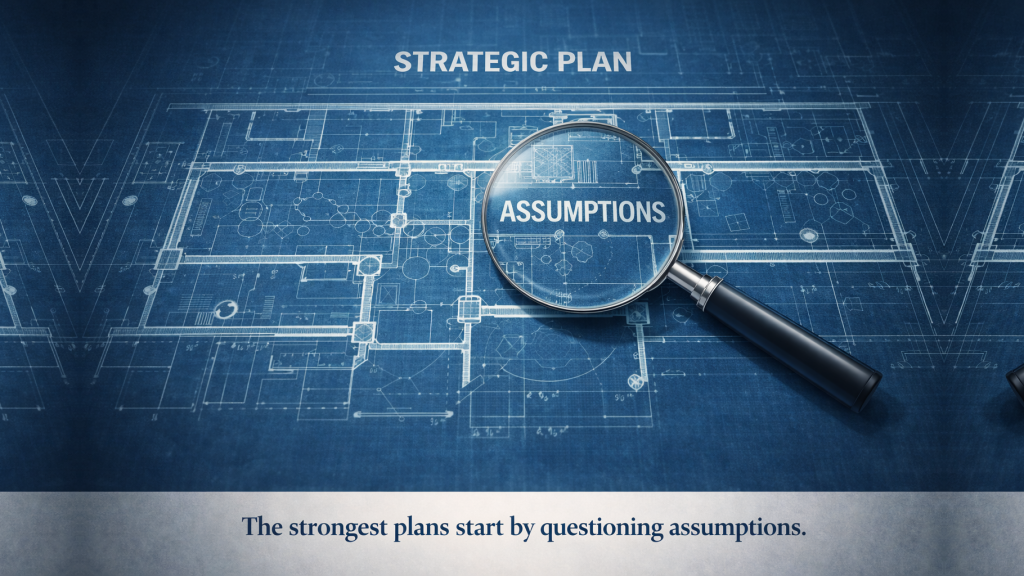
Strategic Projects Don’t Fail. Unchallenged Assumptions Do.
Every strategic project starts with momentum.
Executives align around a vision. Teams are assembled. Resources get committed. The roadmap looks compelling in the boardroom and the energy in the room feels like proof that this time, everything is in place for success.
Then reality shows up.
And more often than not, what derails a strategic project isn’t poor execution, insufficient budget, or lack of talent. It’s something far less visible — and far more dangerous. It’s the assumptions nobody thought to question.
The Plan Looked Solid. So Why Did It Fall Apart?
Every strategic project carries invisible dependencies. The executive sponsor who “will remain” committed through the full lifecycle. The organizational appetite for change that “definitely exists.” The technology that “should” integrate seamlessly. The market conditions that “won’t shift” before delivery.
Nobody documents these as risks because they don’t feel like risks. They feel like reasonable starting points. Shared understanding. Common sense.
Until they aren’t.
Strong strategic project leadership isn’t just about building a compelling plan. It’s about interrogating the ground that plan sits on. Before any roadmap gets finalized, the most powerful question a project leader can put to their team is: “What has to be true for this to work?”
Surface every silent assumption. Write them down. Assign them a confidence level. Some will hold. Others will expose vulnerabilities that were always there — risks you can now design around, escalate early, or build contingencies for before they quietly unravel months of carefully managed execution.
The Greatest Risks to Your Strategic Project Aren’t in Your Risk Register
Most project teams invest significant effort in risk management. They build risk registers, assign probability scores, identify mitigation strategies, and allocate contingency budgets. It feels rigorous. Disciplined. Boardroom-ready.
But the risks that truly cripple strategic projects rarely appear on that list.
They don’t appear because they were never framed as risks in the first place. They were framed as facts.
The assumption that senior stakeholders will remain actively engaged beyond the launch phase. The assumption that the strategic priority driving this project won’t be displaced by the next organizational shift. The assumption that the business case built twelve months ago still reflects the reality the organization is operating in today. Nobody logs these as risks because they feel like foundations — not fault lines.
Until they crack.
History is filled with strategically sound, well-resourced projects that collapsed not from poor execution but from a single assumption that went unquestioned for too long. The more complex and high-stakes the project, the deeper those assumptions tend to sit — and the more catastrophic their failure becomes when they finally surface.
The assumptions most likely to cripple your strategic project share three characteristics:
- They are held by the most senior people in the room — so nobody feels comfortable challenging them, even when doubt exists and the data suggests otherwise.
- They are embedded early in the planning process — so they become structural and foundational, quietly shaping every decision that follows and making them increasingly difficult to revisit as the project gains momentum.
- They are mistaken for consensus — when in reality they were never explicitly discussed or stress-tested. The team simply moved forward as if alignment existed, when what existed was silence.
The danger is that all three characteristics often exist in the same assumption simultaneously — making it invisible, unchallenged, and deeply embedded all at once. That combination is what makes it so lethal to even the most well-governed strategic project.
Where Strategic Project Leadership Must Evolve
Frameworks, methodologies, and governance structures are essential. But they are not sufficient.
The most dangerous assumption in any strategic project isn’t the one the team debates — it’s the one the entire team silently agrees on without ever saying out loud. The one that lives in the space between slides. The one that senior leaders nod at without anyone stopping to verify it.
A truly robust strategic project approach doesn’t just ask “what could go wrong?” It asks “what are we all quietly betting on — and what happens to this project, this investment, and this organization if we’re wrong?”
Because when a core assumption breaks at the wrong moment it doesn’t just create a problem to manage. It can cascade — unraveling timelines, eroding executive confidence, exhausting contingency reserves, and in the most serious cases rendering the entire strategic initiative irrelevant before it ever delivers value.
Build Plans That Survive Contact With Reality
The goal isn’t to eliminate assumptions. Every strategic project requires them. The goal is to know which ones you’re making, stress-test the ones that carry the most organizational weight, and build deliberate contingencies around the ones you simply cannot afford to get wrong.
That discipline — the willingness to challenge what feels obvious before reality does it for you — is what separates project plans that look good in a boardroom from strategic initiatives that actually deliver.
The teams and leaders who consistently execute at the highest level aren’t the ones who predicted every obstacle. They’re the ones who stopped treating assumptions as facts and started treating them as hypotheses that deserve the same rigor as everything else in the plan.
Certainty is a comfort. Clarity is a competitive advantage.